After the water sat
Mold Remediation in Oyster Bay, NY
Mold remediation in the Town of Oyster Bay is a moisture job with a cleaning job attached, in that order. Removing growth from a wall that is still damp buys a few weeks. Finding out why the wall was damp is what makes the difference permanent.
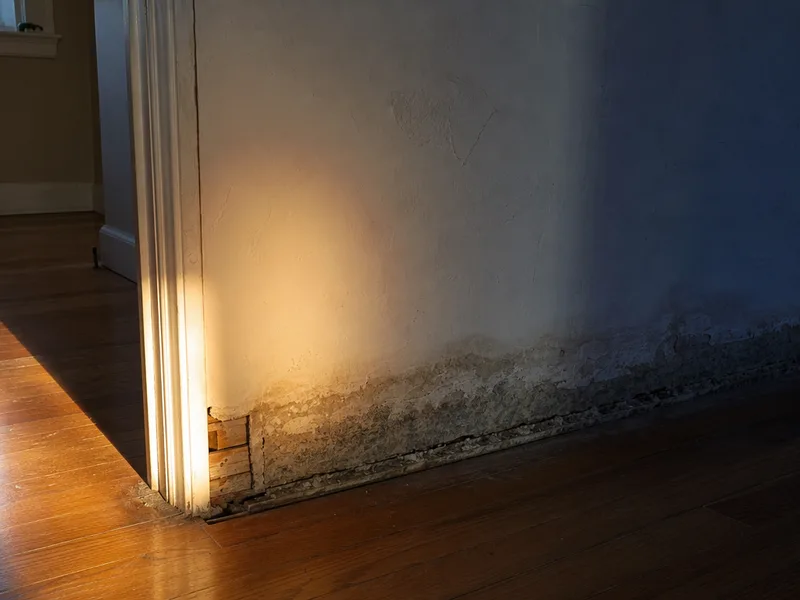
Mold remediation in Oyster Bay, NY nearly always starts with a water event that happened weeks earlier and was dealt with imperfectly. A supply line let go and the floor was dried. A basement took water in a storm and the carpet came out but the wall behind the baseboard did not. A slow leak under a sink was fixed and the cabinet floor was left to dry on its own.
The cleaning is the visible part of the job and the easy part to quote. Why the growth is there in the first place is the part that decides whether it comes back, so most of what follows is about water rather than about mold.
Why mold shows up here, and what actually causes it
Mold spores are already in every house. EPA's position is that it is impossible to get rid of all mold and mold spores indoors, since some are always floating in the air and sitting in house dust, and that the spores will not grow if moisture is not present (EPA, checked 2026-08-31). Spores are already in the room. What changes is whether they have anything to grow on.
The condition is moisture, and EPA puts the window at 24 to 48 hours. Drying water-damaged areas and items within that window prevents mold growth in most cases (EPA, checked 2026-08-31). New York State's own flooding guidance says the same thing in plainer words, advising people to remove standing water, moisture and wet materials to prevent mold and to dry the home quickly (NY State Department of Health, checked 2026-08-31).
Around here the moisture usually arrives one of four ways.
The commonest is a water loss that was dried on the surface. The floor was dry, the wall was not, and the wet part was inside a cavity where nobody looked.
Groundwater is the second, and it is a south-shore problem. Flat ground with a high water table pushes damp through slabs and the base of foundation walls continuously rather than in one event, which is why some south-shore basements have a musty smell that predates any flood anybody remembers.
Runoff is the north-shore version. Water arriving off a slope finds an entry point, wets a small area, and does it again every time it rains hard.
The fourth is ordinary humidity in a room with no ventilation. EPA recommends keeping indoor relative humidity below 60 percent, ideally between 30 and 50 percent (EPA, checked 2026-08-31), and a closed basement in an island summer sits well above that with no leak involved at all.
What mold remediation actually involves
- The moisture source is found and stopped. Anything done before this is temporary by definition.
- The area is contained. Disturbing growth releases spores, and containment keeps that release inside the room being worked on instead of distributing it through the house. This is the step that separates a remediation from a wipe-down, and it explains a large part of the price difference between them.
- Porous material comes out and hard surfaces get cleaned. EPA's guidance is that absorbent materials such as ceiling tiles and carpet may have to be thrown away when they become moldy, because growth fills the spaces and crevices inside the material and cannot reliably be removed from it (EPA, checked 2026-08-31). Hard surfaces are scrubbed with detergent and water and dried completely.
- The area is dried and then checked. Since no laboratory number can declare a house clean, the close-out is a moisture reading in the material, a look for remaining growth and the absence of a musty smell. EPA describes the finish as the water or moisture problem being completely fixed, visible mold and moldy odors gone, no signs of returning damage on a revisit, and people able to occupy the space without symptoms (EPA, checked 2026-08-31).
- It is put back, and not before. Paint applied over a moldy surface is likely to peel, which is EPA's own warning and a reliable way to tell that a previous repair was cosmetic.
Where the line sits between a homeowner job and a remediation job
There is a published threshold, which is unusually helpful in a trade full of opinion.
EPA's guidance is that where the moldy area is less than about ten square feet, roughly a three foot by three foot patch, a homeowner can in most cases handle it by following the published cleanup guidelines (EPA, checked 2026-08-31). Above that, or where there has been a lot of water damage, it points to its remediation guidance for larger buildings and to hiring somebody with real experience of the work.
Three situations move a job across that line whatever its size.
Contaminated water is the first, and it is a category question rather than a size question. Where the damage was caused by sewage or other contaminated water, EPA's advice is to call in a professional with experience of buildings damaged by contaminated water (EPA, checked 2026-08-31). That is the direct connection to sewage cleanup in Oyster Bay.
Hidden growth is the second. EPA lists the usual hiding places as the back of drywall, wallpaper or paneling, the top of ceiling tiles, the underside of carpet and pad, inside walls around leaking or condensing pipes, behind furniture where condensation forms, inside ductwork, and in roof material above ceilings. It also warns that investigating can release a large quantity of spores at once, which is why pulling wallpaper off on a hunch is a bad idea.
The third is who lives in the house. Federal guidance advises that people with asthma, other lung conditions or immune suppression should not enter buildings with visible or smellable mold growth, and that children should not take part in cleanup work. EPA separately notes that mold can trigger asthma episodes in people who are sensitive to it (EPA, checked 2026-08-31).
Mold removal after a water loss, and why the two get confused
Mold removal is what most people are asking for when they call. It describes the visible outcome: the black patch is gone.
The problem with buying only that is the same problem as painting over it. If the material behind the patch is still holding water, the growth returns, and it returns in the same place, which people then read as the work having been done badly rather than as the moisture never having been addressed.
This is also where the two most common causes on this site meet the mold lane. A basement that flooded and was pumped out but never properly dried is the single most common route into a mold job here, which is why flooded basement cleanup puts as much weight on the drying half as on the extraction. Water that came in through the building envelope during weather is the other, and storm damage restoration covers the repairs that stop it recurring.
What it costs, and what actually moves the number
No honest figure can be given from a description, and this site does not publish a price for work it does not carry out. What is worth knowing is which variables matter, because they are the ones a contractor will ask about.
Area comes first, and it means the square footage of affected material rather than the size of the visible patch. The two are rarely the same.
What the growth is sitting on matters next. On painted masonry it is cleaned in place. In drywall, insulation, carpet pad or subfloor it generally means removal, disposal and then a rebuild.
Access can double a small job. Reaching growth behind cabinetry, under flooring or above a finished ceiling means taking those out first and putting them back afterwards.
Containment costs money on its own. A sealed work area with controlled airflow takes time to set up, and it is the practical difference between a remediation and a cleaning.
The cause is the variable with the widest spread. Fixing a supply line is cheap. Fixing chronic groundwater against a foundation is a drainage project, and it is the one that changes the total.
Four questions worth asking before work starts
None of these is a trick. They are the ones that separate a remediation from a cleaning, and a contractor who does this properly will have quick answers.
Ask what is being done about the moisture, and expect a specific answer about a specific source. Ask whether the work area will be contained and how. Ask what is being removed rather than cleaned, and why that line was drawn where it was. Ask how the job will be closed out, and listen for a moisture reading rather than a photograph of a clean wall.
We connect homeowners here with local restoration contractors and pass the details to one of them. We do not carry out remediation, we do not sample or test, and nothing on this site is legal or medical advice. Whether any of it is covered is a question for your own policy, and how a New York water damage claim is framed sets out the shape of that conversation without pretending to answer it for you.
Two of the five hamlet pages raise mold questions more than the others: Syosset and Bayville. The rest of the work is listed on the restoration services page, and the Town-wide view is on water damage restoration across the Town of Oyster Bay.
The published fact that decides how this job ends
No federal limit has ever been set for mold or mold spores in indoor air, so there is no lab result that can declare a house clean. The finish line is a dry moisture reading and a visual check, which is why the moisture problem and not the growth is the thing a job has to close out on.
US EPA, A Brief Guide to Mold, Moisture and Your Home, checked 2026-08-31
Questions people ask about mold remediation
What is the difference between mold abatement and mold remediation?
In everyday use the two words get swapped freely. The distinction worth holding on to is that removal deals with what is visibly there, while remediation is expected to include the moisture source, containment so spores are not spread through the rest of the house, and a check afterwards that the area came back dry. A quote for one is not a quote for the other, and it is a fair thing to ask about before work starts.
Can black mold be fully remediated?
Growth on a hard surface can be cleaned off and the surface dried. Growth that has gone into porous material usually cannot, which is why EPA notes that absorbent items such as ceiling tiles and carpet may have to be thrown away (EPA, checked 2026-08-31). What cannot be achieved at all is a spore count of zero: spores are in ordinary house dust everywhere, and they only grow where there is moisture.
How urgent is mold remediation?
The urgency belongs to the moisture rather than to the growth. While a material stays wet, the affected area keeps expanding and the repair keeps getting larger; once it is genuinely dry, the situation stops moving. How long before mold grows after water damage covers the timing side in detail.
Can you sell a house with mold in NY?
This is a question for a real estate attorney rather than for a restoration site, and anyone who answers it confidently in two sentences is guessing. What is generally true is that buyers, home inspectors and lenders all react to visible growth and to signs of a past water loss, and that a documented remediation with the moisture cause fixed is a very different conversation from a patch of stained drywall and no paperwork.
Do I need a mold test?
Usually not. EPA states that in most cases sampling is unnecessary where growth is visible, and that since no federal limits exist for mold or mold spores, sampling cannot be used to check a building against a federal standard (EPA, checked 2026-08-31). Testing earns its keep when growth is suspected but cannot be found.
Will bleach fix it?
EPA does not recommend using a biocide such as chlorine bleach as a routine part of mold cleanup, and makes the further point that dead mold can still cause allergic reactions, so killing it is not enough and it has to be removed (EPA, checked 2026-08-31). Painting over it does not work either, because paint applied to a moldy surface is likely to peel.
What does mold remediation cost?
The size of the affected area, whether it is on a hard surface or inside porous material, how much has to be opened up to reach it, and what caused the moisture are what move the figure. A patch on painted masonry and the same patch on the back of insulated drywall are the same square footage and not remotely the same job.
What usually happened first
- Flooded Basement Cleanup
Water out, then the structure dried and checked.
- Sewage Cleanup
Contaminated water, removed and the room made safe again.
Not sure whether it needs a professional?
Send a photograph of the patch and roughly how much wall it covers. Size and what is behind it are the two things that decide whether this is a weekend job or a containment job.