The south end of the Town
Water Damage Restoration in Massapequa
Massapequa is the far south end of the Town, where the flat ground that runs down from the hills finally meets the water. Ground like that does not shed water and it does not hold much in reserve either, so the question in a Massapequa basement is less often where the water came in and more often how much of it the ground outside could still take.
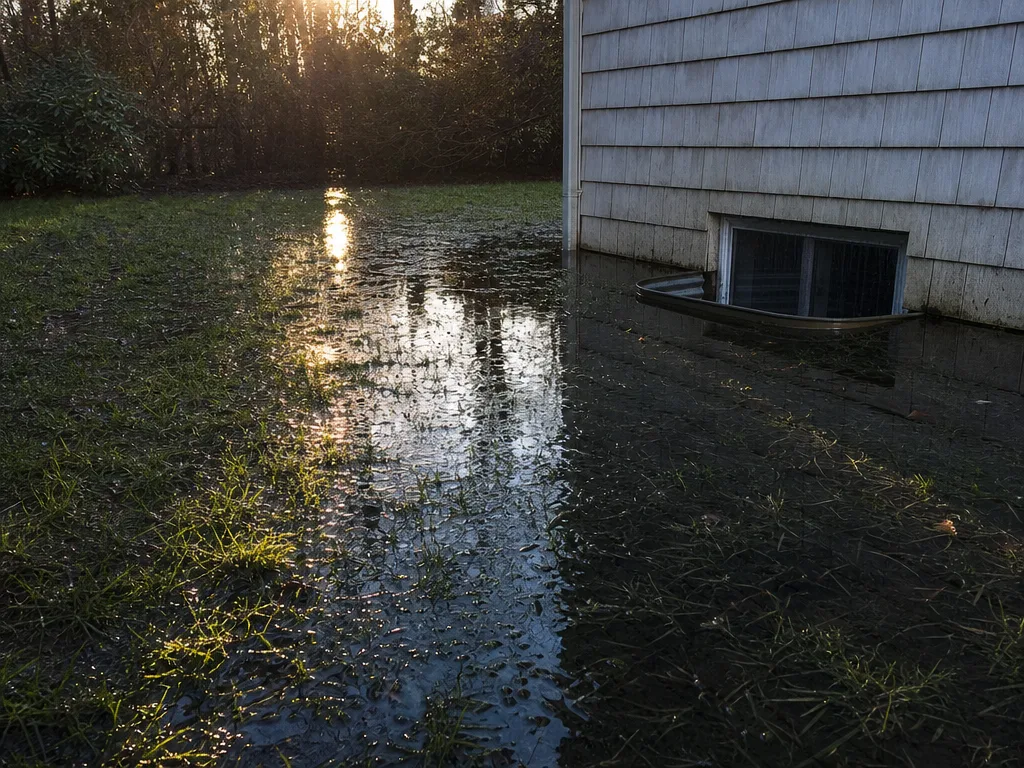
What sits at the bottom of the slope here
What is at the bottom of the slope?
North shore
Deep harbours
Northward flowing streams carved wide, deep harbours, and the sea steepened the headlands between them. Water arriving at the coast there has depth to arrive into.
USGS, New York Water Science Center, Long Island Topography · checked 2026-08-31
South shore · your shore
Shallow bays
Here the plain merges into swampy coastal deposits, and sand, silt and organic material fill the shallow bays behind the barrier beaches. There is no depth for the water to go into.
USGS, New York Water Science Center, Long Island Topography · checked 2026-08-31
What the published record says about this ground
The outwash plain does not stop at a shoreline so much as merge into one: USGS records it sloping south until it meets recent swampy deposits along the coast, with sand, silt and organic material filling the shallow bays behind the barrier beaches, and that is the ground the south end of Massapequa is built on.
USGS, New York Water Science Center, Long Island Topography, checked 2026-08-31
Massapequa is the far south end of the Town, where the flat ground running down from the hills finally meets the water. That is a different situation from anywhere else on this site, and not because it is wetter. It is because the plain does not stop at a shoreline so much as fade into one, and a house near the bottom of it is sitting on ground with less spare capacity than the same house would have four miles north.
What causes most water losses in Massapequa
Two quite different things put water across a floor here, and separating them is the first useful thing anybody does. A failure inside the house is the same job in Massapequa as it is anywhere else, and water damage restoration Oyster Bay describes the sequence it runs in.
The other one is a function of where the house sits. On low, flat, already damp ground an ordinary heavy rain has nowhere to be absorbed. It stands on the surface, finds the lowest opening in whatever is in its way, and that is frequently a window well, a cellar entrance, or the gap where a slab meets a wall.
The two look similar once there is water on the floor and they are not the same problem. One is clean water from a known point that stopped when somebody closed a valve. The other is water that came in from outside, was never clean, and will keep coming while the ground stays loaded. Working out which one happened is the first thing anybody should do, and it is usually answerable from where the water is deepest and what it left behind.
Flood zones, and why a letter on a map is not the whole answer
FEMA's flood maps mark high-risk areas with letters beginning A or V, also called special flood hazard areas, and mark moderate to lower risk areas with B, C or X (FEMA, checked 2026-08-31). Those letters do real work: they decide what a lender insists on and what a policy costs.
What they are not is a prediction about a particular building. They are drawn for insurance and lending, at a scale that cannot see how a specific lot is graded, where its downspouts discharge, or whether the driveway falls toward the house. Two neighbours inside the same band can have completely different experiences of the same storm, and regularly do.
So this page does not tell you which band any address is in, and no restoration company should. Look your own up on FEMA's Flood Map Service Center, which is the authoritative source and is free.
The other half is the insurance half, and it surprises people every year: FEMA notes that most homeowners and renters insurance does not cover flood damage (FEMA, checked 2026-08-31). How a policy treats water that arrived some other way is a longer story, and does homeowners insurance cover water damage in New York works through it. Where wind and rain damaged the building envelope first, that is a different question again, and storm damage restoration is the page for it.
Flooded basement cleanup in Massapequa, and what it involves
Flooded basement cleanup walks through the sequence. The thing that shifts at this end of the Town is not the order of the work, it is where the line falls between what gets dried and what gets carried out to the kerb.
After a clean supply-line failure that line sits fairly far out. Carpet can often be lifted, dried and relaid. Drywall that got damp at the bottom can sometimes be dried in place. The material is wet, and wet is a condition that can be reversed.
After water that came in across or up through ground, the same material is not wet, it is contaminated, and contamination is not a condition drying reverses. So carpet and pad go. Insulation goes. Anything with a paper facing goes. Particleboard and MDF go, because they fail structurally as well as biologically. Drywall gets cut back above the visible line rather than dried down to it.
Homeowners often read that as a contractor being wasteful, and it is worth understanding as the opposite. Everything in that list can be dried to a normal moisture reading and still be carrying what came in with the water. A meter measures moisture. It does not measure what the moisture brought.
Water that came up, and why it changes the job
Water that arrives through the floor rather than through a pipe changes three things at once, and none of them is the volume.
It changes what can be kept, because material that has been in contact with ground water is treated as contaminated regardless of how it looks. It changes who should be doing the work, because contaminated water has handling requirements that a wet vacuum and a fan do not meet. And it changes the timing, because the source does not switch off when somebody turns a valve.
The clock still runs the same way it does on a clean loss. EPA puts the window for drying water-damaged areas and items at 24 to 48 hours before mold growth becomes likely (EPA, checked 2026-08-31), and that window does not extend just because the water is still arriving. It is the reason removing saturated material early is usually cheaper than trying to dry it and failing.
Tell us how the water arrived
Whether it came up, came in at a wall, or came down from above changes almost everything that follows, including who should be doing the work.
Get a quoteServing the Town of Oyster Bay, NY
Questions Massapequa homeowners ask
What causes most water losses in Massapequa?
Interior plumbing, by count. What makes this end of the Town distinctive is how often the other cause turns up: on low ground that is already close to saturated, ordinary rain has nowhere to be absorbed and arrives at a foundation from outside. The two produce a similar-looking wet floor and a very different job, so establishing which one happened is worth doing before anybody quotes anything.
How do FEMA flood zones actually work?
FEMA's flood maps mark high-risk areas with letters beginning A or V, also called special flood hazard areas, and mark moderate to lower risk areas with B, C or X (FEMA, checked 2026-08-31). The letters drive what a lender requires and what insurance costs. They are not a forecast for a particular house, and the only reliable way to find your own is to look your address up on FEMA's Flood Map Service Center rather than taking a number from a contractor.
Will my homeowners policy cover a flooded basement?
It depends entirely on how the water arrived. FEMA notes that most homeowners and renters insurance does not cover flood damage (FEMA, checked 2026-08-31), which is why flood cover exists as a separate product. Water from a burst pipe is a different question again. Read the policy or ask your agent, and see how a New York water damage claim is framed.
Is water that came up through the floor treated differently?
Yes, and the reason is contamination rather than volume. Water that has travelled across or through ground is not clean water by the time it reaches a basement, so porous material that could be dried after a supply line failure is usually removed instead. The rules for handling it are the ones on sewage cleanup, even when nothing has backed up.
Further up the Town, and what changes
- Hicksville
Flat ground and permeable sand, where water leaves downward or does not leave at all.
- Syosset
Mixed ground that drains unevenly, and the wet corner that comes with it.
- Glen Head
Falling ground, where water arrives at a house instead of rising to it.
What kind of job this turns into
Water in a Massapequa basement?
Start with where it arrived and how long it stood. On this ground those two answers decide what can be dried and what has to be cut out.