Above the harbour
Water Damage Restoration in Glen Head
Glen Head sits high on the northern line of hills, on ground that drops away toward the Sound. Water on falling ground behaves like water on any hillside: it moves, it concentrates, and it finds the lowest opening in whatever is in its way. Which means a wet Glen Head basement is usually a question about an entry point rather than about a water table.
How far the land falls to the water here
How far does the land fall to the water?
North shore · your shore
About 100 feet, in places
Wave erosion steepened the northern headlands into nearly vertical bluffs that stand around 100 feet high in places. Ground that falls that hard moves water rather than holding it.
USGS, New York Water Science Center, Long Island Topography · checked 2026-08-31
South shore
About 20 feet in a mile
The plain on the other side of the hills falls at roughly 20 feet per mile all the way to the bays. Over one property that is effectively flat, and nothing gets moved anywhere.
USGS, New York Water Science Center, Long Island Topography · checked 2026-08-31
The published figure behind this page
On this side of the Town the land does not ease down to the water: USGS records wave erosion having steepened the northern slopes of the headlands into nearly vertical bluffs that are, in places, about 100 feet high, and ground falling that steeply delivers surface water to whatever stands at the bottom of it.
USGS, New York Water Science Center, Long Island Topography, checked 2026-08-31
Glen Head sits high on the northern line of hills, on ground that drops away toward the Sound. Water on falling ground behaves the way water on any hillside behaves: it moves, it concentrates as it goes, and it finds the lowest opening in whatever stands in its path. Which means a wet basement here is usually a question about an entry point rather than a question about a water table.
What causes most water losses in Glen Head
Interior plumbing still accounts for most of the work, and it behaves no differently here than it does anywhere else in the Town.
What separates Glen Head from the south end is the second category, and it starts outdoors. USGS records that the many wide and deep harbors along the north shore were carved by northward-flowing streams (USGS, checked 2026-08-31), and the ground between them still falls the way it always did. Rain landing on that ground does not sit where it lands. It gathers into whatever channel exists, natural or otherwise, and a driveway that slopes toward a house is a channel.
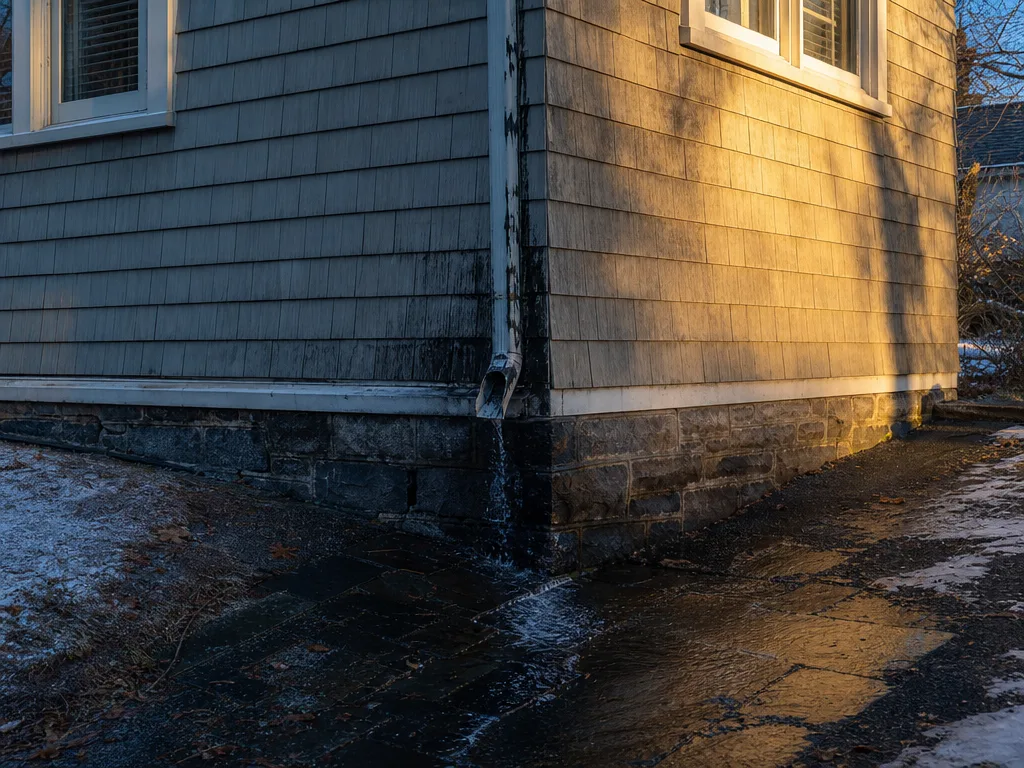
So the characteristic job here starts outside. A leader that has come away from its shoe and is putting a roof's worth of water against a foundation corner. A window well with no drainage that fills faster than it empties. A cellar entrance at the bottom of a slope with a drain that has silted up. None of those is a plumbing fault and none of them is fixed inside.
Water that arrives at the house rather than under it
The practical difference between arriving water and rising water is that arriving water has a direction, and a direction can be traced.
That is genuinely good news for a homeowner. A problem with a path has a place where the path can be interrupted, and interrupting it is usually cheap compared with what the water does if nobody does. Extending a discharge line, regrading a few feet of path, clearing a well drain: none of that is restoration work and all of it prevents the next event.
It also means the inside of the building is often less badly affected than the alarm suggests, because the water was moving rather than standing. Contact time is what damages material, and water that came in, crossed a floor and left through a drain has spent less of it than water that pooled for a week. The sequence a job runs in is the same either way, and water damage restoration Oyster Bay sets it out; what changes here is how much of the material survives it.
Flooded basement cleanup in Glen Head, and what it involves
The steps themselves are on flooded basement cleanup. The part worth knowing before anybody quotes you is that a fast event and a slow one look identical on the day and are not the same job at all.
Water that came in hard, crossed a floor and left through a drain has spent perhaps an hour in contact with the building. Water that seeped in and pooled has spent a week. The first leaves a room that is dirty and frightening and largely recoverable. The second leaves a room that looks better and is in worse condition.
So the first hour of a competent visit here is spent measuring rather than demolishing: how high did it get, how far along the wall did it travel, and how much of what it touched is porous. On a fast event the honest answer is often that less needs to come out than the homeowner expected.
The trap is the opposite one. A dramatic event that drained away tempts people to mop up and move on, and how long before mold grows after water damage is the reason that does not work: the clock starts when the material got wet, not when the water left.
Fixing the outside so the inside stays fixed
Restoration and prevention are two different pieces of work, and on this ground they are unusually easy to tell apart.
Restoration ends when the building is dry and sound. Prevention is everything that stops the same water arriving at the same corner next spring, and almost all of it happens in the first ten feet outside the wall: where the roof water lands, which way the ground falls in the first metre, whether a well or an area drain still drains.
A house that has been dried properly and then left with the same drainage will be dried again. That is not a reason to skip the drying, it is a reason to book the outside work while the cause is still obvious and somebody has photographs of it. Where the same weather also damaged the envelope itself, storm damage restoration is the page for that half of the problem.
Where is it getting in?
A window well, a cellar entrance, a blocked leader, a driveway that runs the wrong way. On sloping ground the entry point is most of the answer.
Get a quoteServing the Town of Oyster Bay, NY
Questions Glen Head homeowners ask
What causes most water losses in Glen Head?
Surface water is the answer people are usually looking for, and it is the one worth checking first here. On ground that falls toward the Sound, rain gathers as it travels and reaches the low side of a building with momentum behind it, so a blocked leader or an undrained window well can be the entire explanation. Interior plumbing accounts for more jobs overall, but it is not what makes this address different.
Does living on high ground mean I cannot flood?
No, and the reason is that height protects against one mechanism and not the other. Being well above the water makes it unlikely that anything rises to meet your foundation. It does nothing about water arriving across the surface from further up the slope, which is the common failure here. Elevation changes where the water comes from, not whether it gets in.
What should I check outside after water gets in?
Leaders and gutters first, then where the downspouts actually discharge, then the fall of paths and driveways, then window wells and cellar entrances. If there is standing water anywhere near the house, treat it carefully: Ready.gov warns that underground or downed power lines can electrically charge floodwater, and advises against touching electrical equipment that is wet or standing in water (FEMA, checked 2026-08-31).
How long can a wet wall wait before it is a bigger job?
Less time than the wall looks like it needs. The visible surface dries first and the material behind it does not, so a wall that seems fine after a few days can still be carrying water in the insulation and the bottom of the studs. That is the state in which a wall gets closed up and becomes a much larger job six months later.
The rest of the coverage, north and south
- Bayville
The one place on this site with its own village government, and water on two sides.
- Syosset
Mixed ground that drains unevenly, and the wet corner that comes with it.
- Hicksville
Flat ground and permeable sand, where water leaves downward or does not leave at all.
Where a Glen Head job usually goes
Water finding its way into a Glen Head basement?
Tell us where it comes in and what happens outside the house when it rains hard. Those two together usually explain the whole thing.