Below grade
Flooded Basement Cleanup in Oyster Bay, NY
Flooded basement cleanup in the Town of Oyster Bay is two jobs wearing one name. Getting the water out is the visible half. Drying what the water soaked into, and proving it is dry, is the half that decides whether you are back here in a month.
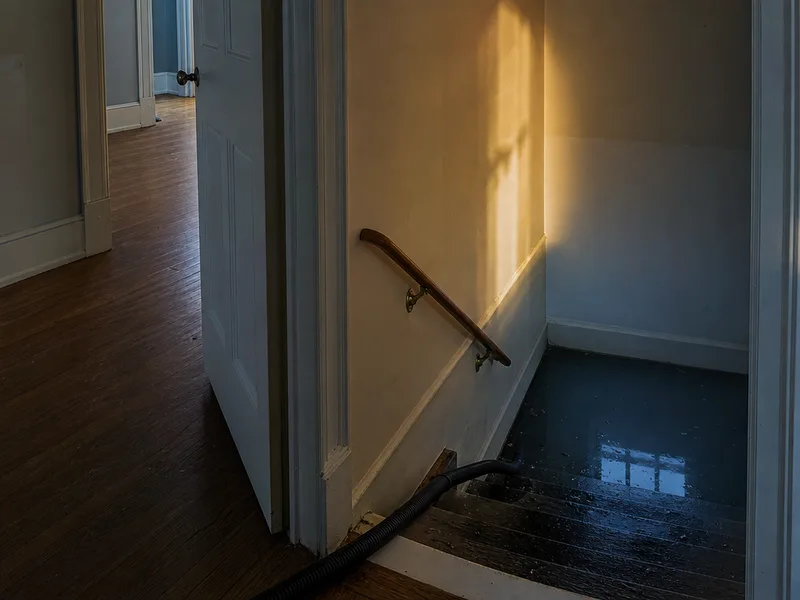
Before the water gets any further
Published safety guidance. None of it is a claim about how fast anybody turns up.
-
Leave the power alone until you know it is safe
Federal guidance is blunt about this: do not touch electrical equipment if it is wet or if you are standing in water, and turn the electricity off only if it is safe to do so (FEMA, Ready.gov, checked 2026-08-31). If the panel is below the waterline, that decision belongs to the utility or an electrician, not to you.
-
Shut the supply off if the water is coming from a pipe
A failed supply line or a split washing-machine hose keeps filling the room until somebody closes the main. The valve is usually near where the service enters the house, often on the wall the meter sits on.
-
Photograph everything before you move it
Wide shots of the room, then close shots of the waterline on the wall and on anything stored on the floor. Photographs taken before the cleanup are the only record of how deep it got.
-
Stay out of standing water you cannot see the bottom of
Ready.gov warns that floodwater can be contaminated and can hide dangerous debris, and that underground or downed power lines can electrically charge it (FEMA, checked 2026-08-31).
-
Get air moving once the room is safe to enter
Open what you can and run fans away from the wall cavities rather than into them. EPA puts the window for drying water-damaged materials at 24 to 48 hours before mold growth becomes the second problem (EPA, checked 2026-08-31).
Flooded basement cleanup in Oyster Bay, NY starts with a question that sounds pedantic and is not: where did the water come from? A supply line that let go behind a finished wall, a sump pump that stopped when the power did, and a storm that pushed groundwater up through the slab all leave the same wet floor and none of them is the same job. The first one is clean water and a drying problem. The last one brings whatever the ground had in it.
A basement is its own case within water damage restoration across the Town of Oyster Bay: it sits below grade, it is the least ventilated room in the house, and almost everything stored in one is porous. A ceiling stain and a flooded basement are both water damage and they are not the same repair.
What flooded basement cleanup actually involves
The order matters more than the equipment list.
- Standing water comes out. Basement water removal is a pump and a wet-vacuum job and it is the fastest part of the day. A few inches across a finished basement is still hundreds of gallons, which is where people underestimate what they have taken on.
- The contents come out. Cardboard, particleboard furniture, carpet pad and anything upholstered that sat in water is usually a loss. EPA is direct about porous materials in its guide to mold, moisture and your home: absorbent items such as ceiling tiles and carpet may have to be thrown away once they are moldy, because the growth fills the spaces inside the material rather than sitting on top of it (EPA, checked 2026-08-31).
- The building dries. This is the half that gets skipped. Air movers break the still layer of air sitting against wet surfaces and a dehumidifier takes the water out of the room instead of moving it somewhere else in the house. Drywall wicks upward, so the wet band runs higher than the waterline you can see, and sill plates, the bottom of studs and the underside of a subfloor all hold water long after the floor is walkable.
- Somebody measures it. A moisture meter reading, taken in the same places on different days, is the only honest way to say a basement is dry. Flood cleanup that ends on a visual check is flood cleanup that gets repeated.
What causes basement flooding in the Town of Oyster Bay
The Town runs from the Long Island Sound shoreline down to the bays on the south side, and the ground under those two halves is not the same ground.
USGS describes the north shore as deeply eroded headlands built from glacial till, with harbors carved by northward-flowing streams and wave erosion that steepened the slopes into bluffs standing about 100 feet high in places (USGS, checked 2026-08-31). Water there travels. It arrives at a foundation with momentum, off a slope, looking for the lowest way in: a window well, a cellar entrance, a crack at the footing.
South of the moraines, the same document describes an outwash plain of well-sorted sand and gravel that begins around 100 to 150 feet above sea level and falls southward at roughly 20 feet per mile until it merges with swampy deposits along the coast (USGS, checked 2026-08-31). That is flat ground with a water table close under it. Water there does not run at a house. It rises, and it comes through the slab and the base of the walls at the same time, which is why a south-shore basement can flood on a day nothing visibly overflowed.
Inside the house, the causes are the ordinary ones: supply lines to a washing machine or an ice maker, a water heater at the end of its life, a frozen pipe in an uninsulated wall, and sump pumps with no battery backup, which fail on precisely the day they are needed.
Basement water removal, and the drying nobody sees
Two numbers decide whether a basement is finished: how wet the materials are, and how wet the air is. EPA recommends keeping indoor relative humidity below 60 percent, and ideally between 30 and 50 percent, to keep mold from establishing itself (EPA, checked 2026-08-31). A basement that has just had several hundred gallons pulled out of it is nowhere near that, and it will not get there by opening a window in August, because the outside air on this island in summer is carrying plenty of its own.
The materials come next. Concrete and masonry hold water and release it slowly. Framing lumber has to come back down to something close to the moisture content of the rest of the house. Anything sandwiched, such as a subfloor with underlayment over it or drywall with insulation behind it, is the last to finish and the first to grow something if it is closed back up early.
Where insulation in a finished basement got wet, it usually comes out. Batt insulation holds water against the framing and hides it from every meter you can put on the surface.
Who to call if your basement is flooded
Three different trades touch this, in this order.
A plumber stops the source if the source is plumbing. A restoration contractor handles extraction, removal and drying. A carpenter or general contractor puts the room back. Some firms do the last two together, some do not, and it is a fair question to ask before anything is torn out.
There is one more office in the sequence and it surprises people. The Town of Oyster Bay's own list of projects that generally require a building permit includes "any interior alterations", "plumbing fixtures", "cellar entrances" and "conversion of garages to habitable space" (Town of Oyster Bay, checked 2026-08-31). A basement being rebuilt after a flood is interior alteration work. The Town runs that division from two offices, one on each shore, which is the same north-south split the geology gives, arriving in administrative form.
What happens if the drying is left half done
Wet framing behind a closed wall is a mold problem waiting for warm weather. EPA's guidance puts the window for drying water-damaged materials at 24 to 48 hours before growth becomes likely (EPA, checked 2026-08-31), and a basement that took several days to dry has already spent that window. When growth has started, the work stops being drying and becomes mold remediation in Oyster Bay, which is a containment job with a different set of rules and a different cost.
So the drying half is worth taking seriously even though it is the dull half. The water is what makes people call; the moisture still sitting in the studs a week later is what makes the bill grow.
Where this applies across the Town
The same job reads differently depending which side of the Town you are on. A flooded basement in Massapequa on the south shore is usually a groundwater and slab problem. A flooded basement in Glen Head on the north shore is usually a runoff and entry-point problem. Both end in the same drying work, but the thing you fix so it does not happen again is not the same thing.
The rest of the work covered here sits on the restoration services page.
The office nobody expects to be involved
The Town of Oyster Bay lists "any interior alterations" and "conversion of garages to habitable space" among the projects that generally need a building permit, so the rebuild half of a basement job is permit work even when the water never came from outside the house.
Town of Oyster Bay, Building Division, checked 2026-08-31
Questions people ask about a flooded basement
Who do you call if your basement is flooded?
It depends what the water is. Clean water from a supply line is a restoration job. Water that came up through a floor drain or a fixture is a contamination job first, which is why sewage cleanup in Oyster Bay is a separate page with different rules. If the water arrived with a storm and the roof or a window is part of the story, storm damage restoration is the lane that covers the building envelope as well as the room.
What do you need to clean up after a flood?
Extraction equipment for the standing water, then air movers and a dehumidifier sized to the room, then a moisture meter to tell you when to stop. The meter is the part homeowners skip. Without one, drying finishes when the floor feels dry, which is usually several days before the framing behind the drywall is.
What causes basement flooding here?
On the south side of the Town, a flat outwash plain and a high water table push water in from below and around the slab. On the north side, runoff off the moraine slope arrives fast and finds the lowest opening in the foundation. Inside the house, the usual suspects are supply lines, water heaters and sump pumps that stopped when the power did.
Can I just pump it out and let it dry?
You can pump it out. Letting it dry on its own is where this goes wrong, because a basement is the least ventilated room in the house and the materials that hold water longest are the ones you cannot see. Read how long before mold grows after water damage before deciding to wait.
Will homeowners insurance cover a flooded basement?
Sometimes, and it usually turns on where the water came from rather than how much of it there was. Surface flooding and a burst pipe are treated as different events by most policies. We do not read policies or file claims, and how a New York water damage claim is framed explains why that line exists.
How much does it cost to clean up a flooded basement?
Depth, square footage, how long the water sat, and whether anything has to come out are the four things that move the number. Nobody can quote it from a description alone, which is why photographs are worth more than a phone call here. Published ranges are collected in what flooded basement cleanup costs.
Where a basement job usually goes next
- Mold Remediation
Growth found, contained, removed, and the moisture behind it fixed.
Still standing in it?
Photograph the room first, then send the details. Depth, how long it has been there, and what the water touched are the three things a contractor needs before quoting anything.