Town of Oyster Bay
About Oyster Bay Water Damage
Write down what the water did, once, and that description goes in front of a restoration contractor who works in the Town of Oyster Bay. That is the whole of it. This is not a restoration company and nobody reading what you send owns a truck.
This site is not taking requests yet. The form has its fields and they work, and it does not send anywhere: nothing is stored, nothing is emailed, and nobody is waiting at the other end of it.
What this actually is
Water damage is one of the few things that can go wrong in a house where the first hour changes the size of the bill, and it is also one where almost nobody has a number to ring. What comes back from a search is mostly two things: national franchises whose phone line answers somewhere else, and directories that take one enquiry and sell it to four companies, all of whom then call you.
This site is the narrow version. You write down what happened, in your own words, with photographs if you took any, and that description is what gets passed on. There is nothing to pay for it and nothing is agreed by sending it. A service like this is paid by the contractor at the other end, never by the homeowner.
The reason to build it that way is that a description beats a phone call at this stage. Depth, what the water touched, and how long it has been sitting are the three things anybody needs before they can say something useful, and none of them survives being relayed by a stranger reading a script.
Which Oyster Bay this means
There are three of them.
Three separate places on this part of Long Island carry the name. There is the Town of Oyster Bay, a municipality that runs clean across the island from the Sound in the north to the bays in the south. There is the hamlet of Oyster Bay, a small place on the north shore with a harbour and its own ZIP code. And there is Oyster Bay Cove, an incorporated village next door to it with a couple of thousand residents.
This site means the Town, and that distinction is worth more than it looks. Most of the people who live in the Town live in hamlets whose names contain no Oyster Bay at all: Hicksville, Syosset, Massapequa, Plainview, Bethpage, Jericho, Farmingdale. If your address is one of those, you live in the Town of Oyster Bay and you are inside the area this site is written for, whatever your mail says.
Five of those hamlets have pages of their own, and the reason is narrower than it sounds: their search results are clean enough to be worth writing a page for. Coverage is the whole Town regardless. The areas we cover are grouped by which shore they sit on rather than listed alphabetically, because that grouping is the useful one.
One Town, two kinds of ground
A ridge of hills left by the last glacier runs east to west through the middle of the Town, and the ground on either side of it is not the same ground. North of it the land falls in bluffs and stream-cut harbours toward Long Island Sound, on mixed glacial till. South of it lies the outwash plain, sand and gravel laid down flat by meltwater, running on until it meets the marshy ground behind the barrier beaches (USGS, New York Water Science Center, checked 2026-08-31).
That is not local colour. It is the reason the same storm produces two different jobs fifteen minutes apart by car: on the north side water arrives at a house from uphill and concentrates against whatever is at the bottom of the slope, and on the south side it has nowhere lateral to go and comes up instead. A basement fails differently at each end, and the hamlet pages are written that way rather than written once and renamed.
The work itself
Most people picture the pump, and the pump is the short part. What decides whether a house is finished is the drying that happens after the visible water has gone, and what the water was decides most of the rest. There are four accounts of that on this site:
- Flooded basement cleanup, which is water out first and then drying the structure it soaked into.
- Sewage cleanup, which is a different job from the moment it starts, because what came up was not clean.
- Mold remediation, for a leak that was left alone long enough to become a second problem.
- Storm damage restoration, where the building envelope is repaired before anything inside it is worth drying.
The guides answer the three questions people search for before any of that: how long there is before mold, how a New York claim is usually framed, and what the work costs.
What this site will not do
The list is longer than usual, on purpose.
It will not tell you how fast anybody gets there
Every other result in this search publishes a number of minutes. This one publishes none, because there is no crew here to hold to it and a figure nobody can keep is worth less than no figure at all. What can honestly be said about time is a fact about water rather than a promise about a company, and it has its own page.
It claims no badge, no certification and no insurance status
Those are claims about a specific person doing a specific job, and no contractor has been picked yet, so any of them would be about somebody who does not exist. When one is picked and their paperwork has been looked at, that is a different sentence and it can be written then.
It shows no reviews and no star rating
There are none. A water damage search is full of invented ones, and the cheapest way not to be part of that is to leave the slot empty.
It does not touch your insurance claim
In New York, acting for a homeowner on an insurance claim is a licensed activity, and nobody connected to this site holds that licence. Explaining how a claim is generally framed is fine and there is a page doing it. Filing one, negotiating one or billing an insurer is not something on offer here at any price.
It publishes no price list
Nobody can price a wet room from a description, and a range invented to fill a table is the same problem as an invented review. One page carries every cost figure this site publishes, each with the body that published it: what a flooded basement cleanup costs.
The pictures
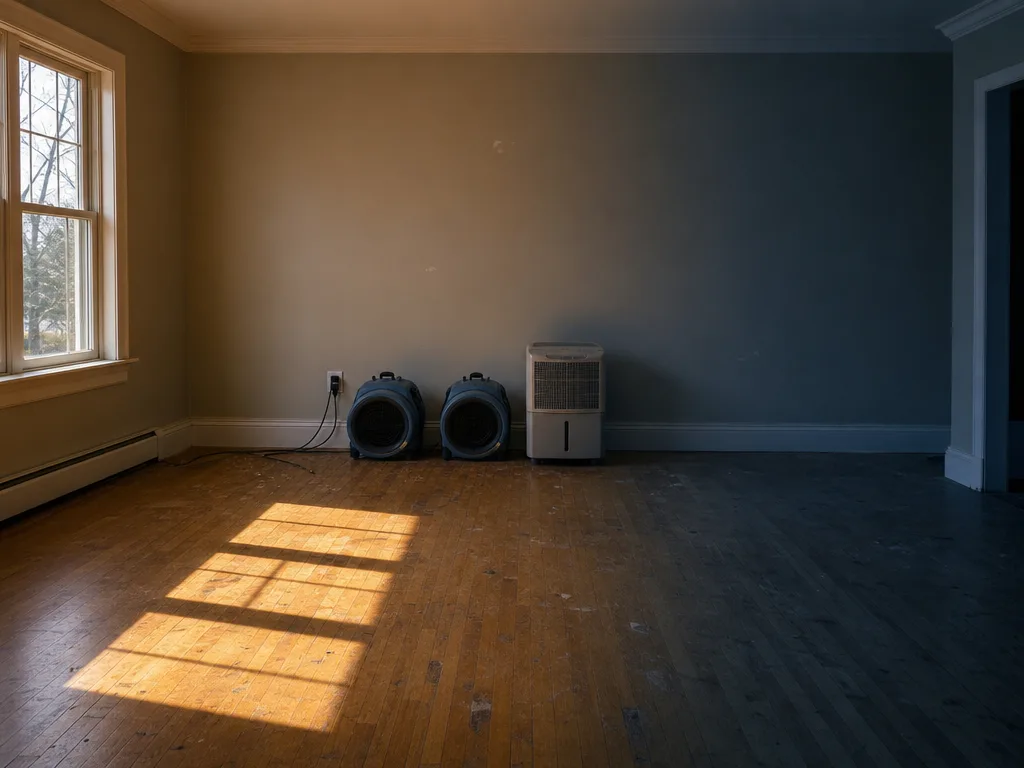
None of the imagery here was taken with a camera. It is all made. It shows what a wet room looks like rather than what anybody's crew did to one, it is never captioned as a job, and it is never set out as a before and after. Faked proof of work is the trick this trade is known for, and the way to avoid it is to carry none.
Where a number appears anywhere here, whoever published it is printed beside it along with the day it was read. That covers the guides, the service pages and the hamlet pages without exception, and it is the entire editorial policy.
Getting hold of us
The contact page has the form and says what happens to what you put in it, including how the phone side of this works. The form is not sending yet.
Serving the Town of Oyster Bay, NY