South of the ridge
Water Damage Restoration in Hicksville
Hicksville sits on the outwash plain, south of the line of hills that splits the Town, on ground that glacial meltwater laid down almost level. That is not scenery. It decides what a wet basement here usually turns out to be, and it is the reason a Hicksville job and a job four miles north rarely have the same cause.
What the ground under Hicksville does with water
What carries the water away?
North shore
Slope, into harbours
Streams flowing north cut the wide deep harbours along the Sound, and the land still falls toward them. Water that lands on a north shore lot has somewhere to run to.
USGS, New York Water Science Center, Long Island Topography · checked 2026-08-31
South shore · your shore
About 20 feet in a mile
The outwash plain slopes south at roughly 20 feet per mile, which is close to level across one property. Water leaves downward through the sand and gravel, or it stays where it is.
USGS, New York Water Science Center, Long Island Topography · checked 2026-08-31
The published measurement this page rests on
The outwash plain that Hicksville sits on is composed of well sorted sand and gravel and slopes southward at a rate of about 20 feet per mile, which is close to level across a single property, so water that reaches a foundation here has nowhere lateral to go and leaves downward or not at all.
USGS, New York Water Science Center, Long Island Topography, checked 2026-08-31
Hicksville sits well inland, on the flat sheet of sand and gravel that glacial meltwater spread south from the hills. Ground like that has one obvious property and one that catches people out. Water soaks into it readily, which is why the streets drain. And it has almost no fall across a single lot, which is why once water has got inside a foundation there is nothing outside pulling it back out.
What causes most water losses in Hicksville
Most of the jobs on this ground start indoors. A supply line behind a washing machine, a water heater that lets go at the bottom of the tank, a burst pipe in an unheated section of wall, a dishwasher that has been leaking quietly under a cabinet for a month. None of that has anything to do with geography, and it is the majority of the work everywhere.
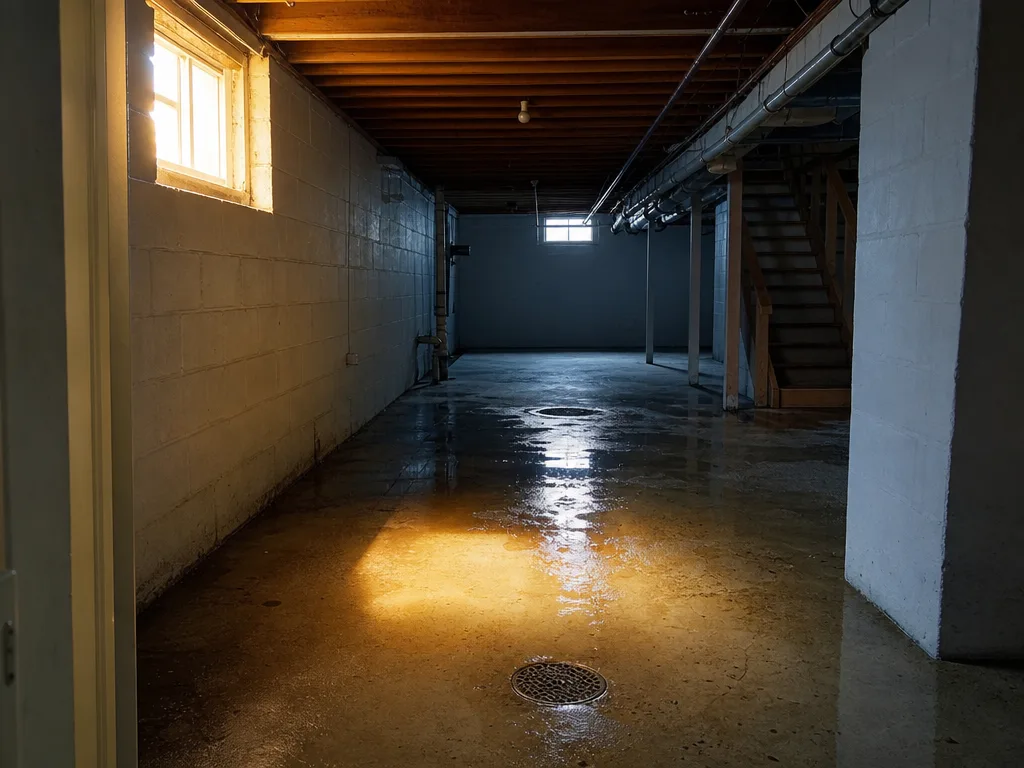
Geography changes the second category. Where the ground is flat and already wet, a basement can take water with no single event to point at. A long wet fortnight raises the level under the whole neighbourhood at once, and it comes up through a cold joint, a crack in a slab, or the seam where the floor meets the wall.
People describe that as a leak, go looking for the hole, and cannot find one. There is no hole. The floor is simply below the level the water has reached, and it keeps arriving until the ground outside drops again.
Why flat ground changes what a wet basement means
On a hillside water behaves like a trespasser. It arrives from somewhere, gets in at a point, and leaves when the rain stops. On flat ground it behaves more like a tide: it rises, it sits, and it goes down on its own schedule.
That changes the diagnosis, and the diagnosis is what decides the cost. A point of entry can be fixed. A saturated lot cannot be fixed by anything done inside the house, so the honest split here is drying the building properly now and treating the outside as separate drainage work later, on a longer timescale and usually by a different trade.
It also changes the clock. Water that arrives and drains away has a short contact time with the building. Water that stands has a long one, and contact time is what decides whether a sill plate and the bottom of a stud bay get dried or get replaced. The general account of water damage restoration Oyster Bay covers the sequence a job runs in; what is particular to Hicksville is how long the material tends to have been wet before anybody starts.
Flooded basement cleanup in Hicksville, and what it involves
The steps are the ordinary ones and flooded basement cleanup sets them out in order. What is worth saying here is the question that comes before any of them, because on this ground it is a real question and almost nowhere else is.
Is the water still arriving?
After a pipe failure the answer is no as soon as somebody closes a valve, and drying can start immediately. After a wet fortnight the answer can be yes for days, and equipment run against a source that has not stopped burns electricity and achieves very little. Somebody has to decide whether this is a room to dry now or a room to keep clear and monitor until the ground outside gives up.
Getting that wrong is expensive in both directions. Wait too long and material that could have been saved is past saving. Start too early and the whole thing is run twice.
The other Hicksville-specific point is how far down the damage sits. Where water came up rather than in, the wet band is usually low on the wall and the ceiling is untouched, so the temptation is to treat it as minor. What is low on the wall is also what the building stands on.
What gets dried, and what gets thrown away
Solid material generally dries: framing, concrete, masonry, solid timber, and plaster if it was reached early enough. What leaves is the material that holds water in a way that cannot be reversed. Fibreglass insulation, carpet pad, particleboard, MDF and ceiling tiles are the usual list, and they go not because they are wet but because they stay wet long after the surfaces around them read dry.
The line between a homeowner job and a called-in job is worth being plain about. EPA says that if a moldy area is less than about 10 square feet, in most cases a homeowner can handle the job themselves (EPA, checked 2026-08-31). Above that, or where the water was not clean, it stops being a cleaning question.
Two pages cover the rest of it: mold remediation for what removal actually involves, and how long before mold grows after water damage for the published window and where that figure comes from.
Tell us what is wet in Hicksville
Where the water is, how long it has been there, and what the floor and the lower walls are made of. That is usually enough to say what the job is.
Get a quoteServing the Town of Oyster Bay, NY
Questions Hicksville homeowners ask
What causes most water losses in Hicksville?
Plumbing, mostly, and that is true anywhere: a supply line behind a washing machine, a water heater letting go at the base of the tank, a pipe in an unheated wall. The category that is local is the second one. After a long wet spell the ground under a whole street can be saturated at once, and water arrives through a cold joint or a slab crack with no single event to blame it on.
Why does my basement get damp when it has not rained hard?
Because on this ground the trigger is usually cumulative rather than dramatic. A fortnight of ordinary rain puts more water into a flat, permeable lot than one heavy afternoon does, and the level underneath comes up slowly. A basement that stays dry through a thunderstorm and goes damp in a wet March is behaving normally for the ground it sits in.
Does homeowners insurance cover restoration work?
It depends what the policy calls the event, and the wording matters more than the damage does. Sudden accidental discharge from plumbing is usually treated differently from gradual seepage, and differently again from flood, which is generally a separate product. Read your own policy or ask your agent. How a New York water damage claim is framed sets out the distinctions without pretending they are simple.
Is a sump pump enough on ground this flat?
A sump manages water, it does not remove the reason there is water. On a lot with almost no fall it is doing real work and it has two weak points worth knowing about: where the discharge line ends, because water put out three feet from the wall comes back, and what happens in a power cut, since the wettest nights and the outages tend to arrive together.
Nearby, and which side of the ridge each one is on
- Syosset
Mixed ground that drains unevenly, and the wet corner that comes with it.
- Massapequa
Where the plain stops being a plain and starts being the edge of a bay.
- Glen Head
Falling ground, where water arrives at a house instead of rising to it.
The work itself, by type
Water standing in a Hicksville basement?
Say where it is coming in and how far it has spread. On flat ground the answer usually turns on how long it has been standing rather than on how deep it got.