Mold timing
How Long Before Mold Grows After Water Damage?
The usual answer is 24 to 48 hours, and it comes from a real published source rather than from the industry. What almost nobody quotes is the two sentences the same source puts either side of it, and those are the ones that change what you actually do.
Published August 31, 2026 By Oyster Bay Water Damage
The published window, and the two qualifiers on it
24 to 48 hours
The window EPA gives for drying water-damaged areas and items, which prevents mold growth in most cases.
US EPA, A Brief Guide to Mold, Moisture and Your Home, checked 2026-08-31May already have happened
EPA also states that even where materials are dried inside 48 hours, mold growth may have occurred.
US EPA, Mold Remediation in Schools and Commercial Buildings, chapter 4, checked 2026-08-31Not a deadline
And that growth will not always occur after 48 hours, because the figure is published as a guideline rather than as a rule.
US EPA, Mold Remediation in Schools and Commercial Buildings, chapter 4, checked 2026-08-31Ask this question anywhere and you get one number back, usually with no publisher attached to it. It turns up on restoration sites, in insurance blogs and in the first paragraph of most of what ranks for this search, always stated as though it settled the matter.
The number is real, and it comes from the US Environmental Protection Agency, whose guidance is that drying water-damaged areas and items inside 24 to 48 hours prevents growth in most cases (EPA, checked 2026-08-31). New York State's own flooding guidance gives the same instruction in plainer language, telling people to get standing water and wet materials out and to dry the building quickly (NY State Department of Health, checked 2026-08-31).
What gets left out is that the same agency publishes two qualifiers on it, and between them they change what the number is for.
What the window actually promises, and what it does not
Both qualifiers sit in a footnote to the water damage table in EPA's remediation guide, and they point in opposite directions.
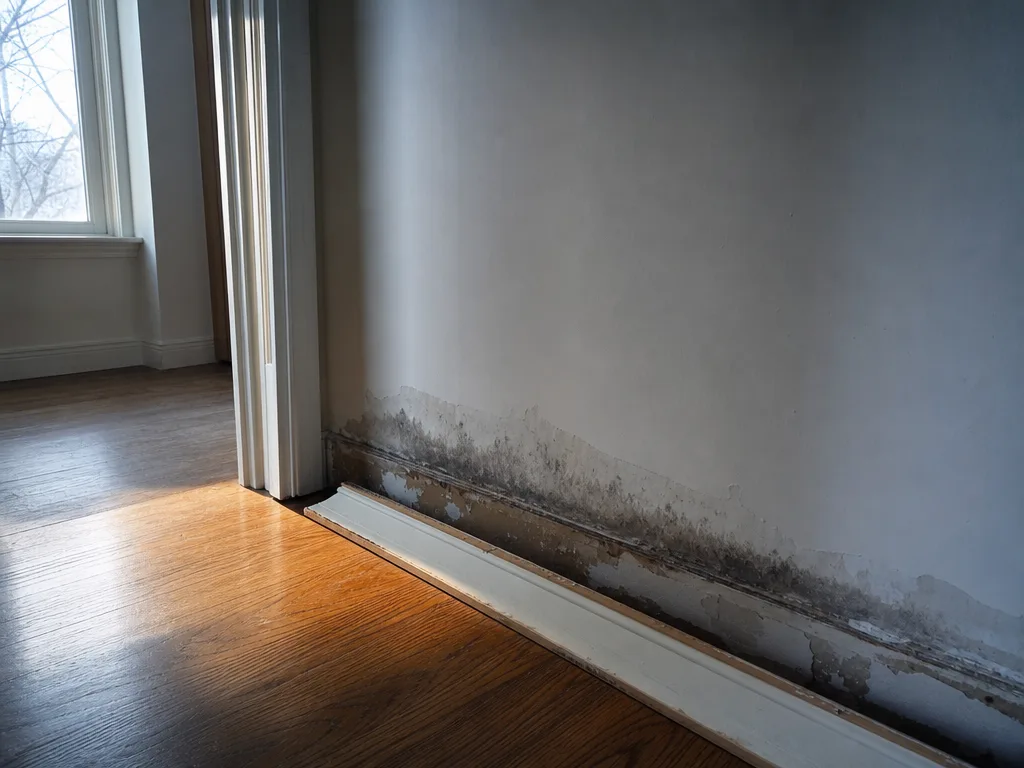
The first is that being inside the window is not a guarantee. Even where materials are dried within 48 hours, growth may already have occurred (EPA, checked 2026-08-31). Drying fast makes it much less likely. It does not make it impossible, and a room that was dried quickly can still have something behind the baseboard.
The second is that being outside the window is not a verdict. Growth will not always occur after 48 hours, because the figure is published as a guideline rather than as a rule (EPA, checked 2026-08-31). A basement that stayed wet through a long weekend has not automatically become a remediation job.
Put together, the window is a planning rule about materials rather than a countdown on a clock. It tells you how fast to move to make growth unlikely. It does not tell you what happened in any particular wall, and no published figure can, which is why the honest close-out of a wet room is a moisture reading and not a date.
Why the material matters more than the hour
The reason a single number can only ever be a guideline is that the things in a house dry at completely different speeds, and some of them do not dry at all.
EPA's table sets out what to do with each of them inside that first 24 to 48 hours (EPA, checked 2026-08-31). Carpet and its backing are to be dried inside the window, with the water pulled out by extraction vacuum and the room dehumidified. Concrete and cinder block get the same extraction and then heat, fans and dehumidifiers to push the drying along. Wooden surfaces need the moisture taken off immediately, with gentle heat and air movement, and wet panelling pried away from the wall so the back of it can dry.
Others are treated as losses from the start. Ceiling tiles are to be discarded and replaced. So is cellulose insulation. Upholstered furniture may simply be too difficult to dry completely inside 48 hours, and the guidance says so rather than pretending otherwise. Wallboard can sometimes be dried in place, but only where there is no obvious swelling and the seams are still intact.
That list is why two rooms that took the same amount of water on the same evening can be in completely different positions on the Wednesday. The one with a tiled floor and painted masonry is a drying problem. The one with carpet, a padded underlay and a stud wall with insulation in it has three materials in it that hold water where nobody can see it and no meter on the surface will find it.
The qualifier that changes everything: what kind of water
There is a further limit on the published window that matters more than the hours do, and it is easy to miss because it sits at the end of the footnote.
The drying guidance is written for damage caused by clean water. Where the source is known or suspected to be contaminated with sewage, or with chemical or biological pollutants, protective equipment and containment are required, and the advice is to bring in somebody experienced with that kind of work (EPA, checked 2026-08-31).
That is not a timing rule at all. It is a category rule, and it overrides the timing. A clean supply line that let go on Friday and a backup from a drain that did the same thing are the same volume of water and are not the same problem on Monday, whatever the clock says. What changes about the second one is covered on sewage cleanup.
The same goes for anything that arrived from outside. Federal guidance on floods is to avoid wading in floodwater at all, because it can be contaminated and can carry dangerous debris, and to keep away from electrical equipment that is wet or standing in water (FEMA, checked 2026-08-31). A basement that took groundwater in a storm is not being assessed against a 48 hour target, it is being assessed on what came in with the water.
So what should you actually do with the number
Treat it as a reason to start today rather than as a test you have passed or failed.
If the water was clean and it happened in the last day or two, the whole job is drying, and speed genuinely helps. Get the water out, get air moving across the wet surfaces rather than around the room, and pull up anything soft that sat in it. Open up what can be opened without damage, because the parts that finish last are the ones sandwiched inside something else.
If it happened last week, stop trying to work out whether you made the deadline. Look instead. A musty smell in a closed room is information. So is a stain that is still cool to the touch, a section of baseboard that has lifted, or a floor covering that has changed shape. If the material is still wet after a week, the drying half was never finished, whatever was done on the first day.
If you cannot tell, the thing that resolves it is a moisture reading in the material rather than a look at the surface, taken in the same spot on different days so that the direction is visible. Two readings a day apart answer the question that a calendar cannot.
What a wet room looks like a week later on either side of the Town
There is a local version of this, and it is worth knowing which one applies before you decide the room has dried.
North of the ridge of hills that runs through the middle of the Town, the ground is mixed glacial material and the land falls toward the Sound. Water arrives at a building from somewhere uphill of it, gets in at one point, and then stops arriving when the weather does. Those rooms genuinely do dry, and the window is a fair way to think about them, because the source has an end.
South of it the ground is flat sand and gravel with the water table sitting close underneath. Water there does not run at a house so much as come up under it, and it can keep doing that for days after the rain stopped. A south-shore basement can be inside its 48 hours in the sense that somebody started drying it straight away, and still be wet on the Thursday because the supply of water never actually stopped. The window assumes the source has been dealt with, and that assumption is doing a lot of quiet work.
That is the practical difference between the two halves of the Town, and it is the reason a general timing rule is a starting point rather than an answer. Flooded basement cleanup goes into what the drying half involves once the source is closed off.
The other question people usually have at this point is who pays for any of it, and that has a separate and less satisfying answer: how a New York homeowners policy treats water damage sets out the shape of it. If the room has already been dried and something has appeared anyway, the work is mold remediation rather than drying, and that page describes what it involves.
Questions people ask
How long does water damage restoration take?
The extraction is usually the short part and the drying is the long one. Standing water comes out in hours; getting the materials around it back to a normal moisture content is measured in days, and how many depends on what got wet rather than on how much water there was. A concrete slab and a sheet of drywall that took the same puddle finish at different times.
Does mold grow in 24 hours?
It can, and EPA is explicit that drying inside 48 hours does not guarantee nothing started (EPA, checked 2026-08-31). That is why the useful question is not whether the deadline has passed but whether the material is dry now and what it is made of.
What if the water sat for a week?
Then the question stops being prevention and becomes a question about what is there. EPA directs anyone dealing with materials wet for more than 48 hours to its remediation guidance rather than its drying guidance (EPA, checked 2026-08-31), which is a different job with containment in it.
Does it matter what kind of water it was?
Enormously, and it is the qualifier most articles leave out. EPA states that its drying guidance is for damage caused by clean water, and that where the source is contaminated with sewage or with chemical or biological pollutants, protective equipment and containment are required (EPA, checked 2026-08-31). See sewage cleanup for what changes.
How urgent is mold remediation?
Less urgent than the drying, and that ordering surprises people. Growth that has already happened is not racing anywhere as long as the material it is on has stopped being wet, so a remediation booked for next week is usually fine. Water still in the structure is the part with a clock on it. That is why the honest sequence is dry first, assess second, remediate third, and why a contractor who wants to start removing before anything has been measured has the order backwards. What the work involves is on mold remediation.
Something got wet and you are not sure how long ago
Tell us what the material is, roughly when it got wet and whether it has been dried since. Those three things decide whether this is a drying question or a remediation question, and they are quicker to describe than to guess at.
Get a quoteServing the Town of Oyster Bay, NY
The work this guide is about
- Mold Remediation
Growth found, contained, removed, and the moisture behind it fixed.
- Flooded Basement Cleanup
Water out, then the structure dried and checked.
- All restoration services
Where these figures come from
Every number above was read from the publisher rather than from another restoration company. Four of the operators ranking for this question publish a growth window and name no source for it, which is the reason this list exists.
- US Environmental Protection Agency Mold Remediation in Schools and Commercial Buildings, chapter 4: water damage cleanup and mold prevention Checked 2026-08-31
- US Environmental Protection Agency A Brief Guide to Mold, Moisture and Your Home Checked 2026-08-31
- New York State Department of Health Weather Emergencies: Extreme Weather and Flooding Checked 2026-08-31
- FEMA Floods (Ready.gov) Checked 2026-08-31